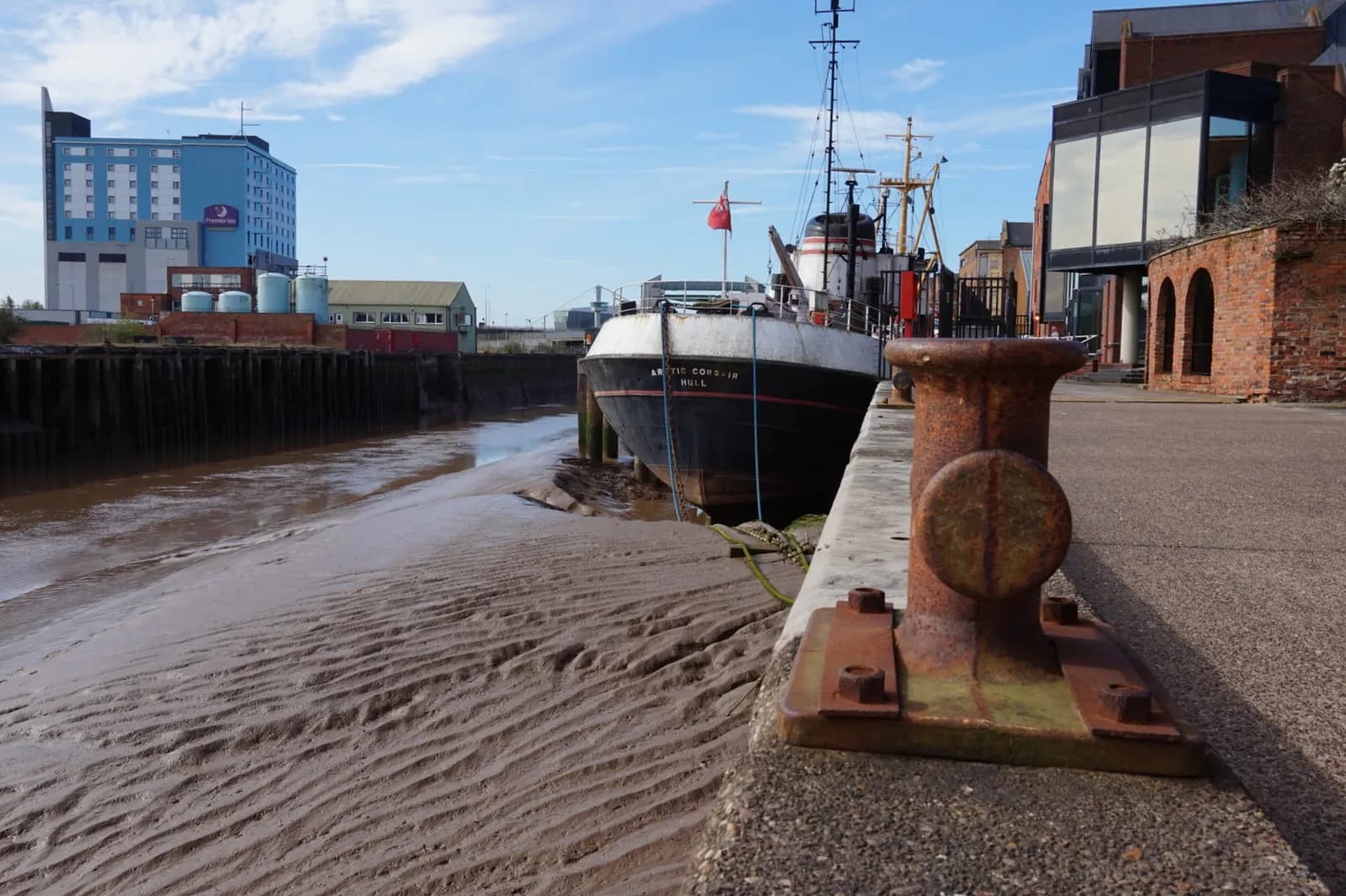
The Arctic Corsair, moored on the River Hull, is the last surviving sidewinder trawler in the United Kingdom. The vessel stands as a memorial to the 58 men who perished in the triple trawler tragedy of 1968 and to the more than 6,000 Hull fishermen lost at sea between 1835 and 1980.
The Vessel
Built by Cook, Welton and Gemmell of Beverley, the Arctic Corsair was launched on 29 February 1960. The 187-foot vessel, powered by a 1,800 brake horsepower Mirrlees Monarch diesel engine, was designed for the punishing conditions of the Icelandic fishing grounds. Unlike later welded vessels, her hull was riveted, a construction method chosen for its strength in heavy seas.
The trawler was built for Boyd Line of Hull and operated as a side-fishing vessel, with her trawl winch and gear mounted on the side rather than astern. This design earned her the designation "sidewinder," a type that once formed the backbone of Hull's deep-sea fishing fleet.
Throughout her working life, the Arctic Corsair experienced both triumph and near-disaster. In September 1967, she collided with the Irish collier Olive in thick fog off Scotland. Holed on her starboard side, she was beached in Sinclair Bay but later repaired and returned to service. In 1973, she broke the world record for the landing of cod and haddock from the White Sea.
Her most dramatic encounter came during the Cod Wars of 1976. On 30 April that year, after the Icelandic offshore patrol vessel ICGV Óðinn made three attempts to cut her trawl warps, the Arctic Corsair rammed the Óðinn in the stern. Skipper Charles Pitts later told reporters that Icelandic seamen were becoming "more ambitious and dangerous in their tactics." The collision holed the Corsair below the waterline. Royal Navy personnel patched the damage, but she was out of action for several months.
The vessel was converted for midwater trawling in 1978 and laid up in Hull from 1981. She was briefly brought out of retirement in 1985, renamed Arctic Cavalier in 1988, and finally retired from fishing in 1993.
The Triple Trawler Tragedy
The winter of 1968 brought catastrophe to Hull's fishing community. Between 11 January and 4 February, three trawlers from the port were lost with nearly all hands. The disaster would claim 58 lives and leave only one survivor.
The St Romanus sailed from Hull on 10 January 1968. The vessel was carrying 20 men when she vanished 110 miles off Spurn Point. Her final radio telephone call came on the evening of 10 January. A Mayday call heard by another ship on 11 January was never passed on. A liferaft was found on 13 January, but alarm was not raised until 26 January. The inquiry could not determine the cause of her loss.
The Kingston Peridot also sailed on 10 January, bound for fishing grounds off north-east Iceland. She carried 20 men. Her final radio message reported difficulties with ice build-up on the ship. She was lost on 26 or 27 January, probably capsized due to instability in extreme weather. Debris was found subsequently.
The Ross Cleveland sailed on 20 January with 19 men. One crew member, Colin Ireland, had been put ashore for medical treatment before the vessel reached Iceland. On 4 February, while attempting to move to a safer position outside Skutulsfjörður fjord during hurricane-force winds and blizzards, the trawler was overwhelmed. Ice had built up on her superstructure, rendering her insufficiently stable for the conditions.
Captain Phil Gay's final radio transmission was heard in Hull:
"I am going over. We are laying over. Help me. I am going over. Give my love and the crew's love to the wives and families."
Mate Harry Eddom survived. He was washed ashore in a liferaft on 6 February, two days after the sinking. Two other men had been in the raft with him, but both died of exposure before reaching land. Eddom was the sole survivor of the triple tragedy.
The Headscarf Revolutionaries
The disaster ignited a campaign that would transform maritime safety in Britain. Led by fish-filleting worker Lillian Bilocca, a group of Hull women who became known as the "Headscarf Revolutionaries" demanded action.
Bilocca was joined by Christine Jensen, Mary Denness, and Yvonne Blenkinsop. They formed the Hessle Road Women's Committee and stormed the offices of trawler owners. Within ten days, they had gathered 10,000 signatures for a "Fishermen's Charter" demanding full crewing of ships, compulsory radio operators on every vessel, improved weather forecasts, better training for trainees, enhanced safety equipment, and a mother ship with medical facilities to accompany the fleet.
Bilocca became a national figure. When trawler owners attempted to sail under-manned vessels, she had to be restrained by four police officers. She travelled to London and met Prime Minister Harold Wilson at Downing Street. When progress stalled, she issued a public threat: "If I don't get satisfaction I'll be at that Wilson's house, private house, until I do get satisfaction in some shape or form."
The campaign succeeded. All demands were granted by government ministers. The actions of Bilocca and her fellow campaigners have been described as "one of the biggest and most successful civil actions of the 20th century." Their story pushed the Vietnam War off the front pages of national newspapers.
Lasting Change
The Holland-Martin Committee of Inquiry, established to investigate safety in the British fishing industry, published its report in May 1969. Its recommendations brought tighter regulation of trawler design and construction, improved safety equipment, legal standards for radio equipment and operators, and widespread improvements to employment, training, and working practices.
Compulsory radio operators became law. Ice build-up on superstructures, which had contributed to the loss of both the Kingston Peridot and Ross Cleveland, became a focus of safety inspections.
The tragedy continued to influence legislation decades later. Harry Eddom's survival was cited in Parliamentary debates in 1986 over the Safety at Sea Bill.
Preserving the Past
In 1991, Adam Fowler of the fishing heritage group STAND led a campaign that secured £45,000 from the Department of Trade and Industry Hull Task Force. Hull City Council purchased the Arctic Corsair in 1993.
Trainees and volunteers from STAND restored the vessel. She opened as a floating museum in 1999, berthed between Drypool Bridge and Myton Bridge on the River Hull. For two decades, visitors could board the last sidewinder and learn of Hull's fishing heritage.
In August 2019, the Arctic Corsair was moved to a temporary berth in Alexandra Dock. In October 2021, she was towed to Dunston's shipyard for extensive restoration work as part of the £27.4 million Hull Maritime City project. She will eventually move to a permanent berth in the redeveloped North End Shipyard in Dock Office Row.
The vessel is operated by volunteers with support from Hull City Council. She remains temporarily closed during restoration.
Memory and Remembrance
Hull has not forgotten the 58 men who perished or the woman who fought to ensure such a tragedy could not happen again.
A plaque unveiled by Hull City Council in Hessle Road in 1990 commemorates Lillian Bilocca and the campaigners. The Hull Maritime Museum displays material on the fishing industry and the Headscarf Revolutionaries. A blue plaque was unveiled on Bilocca's former home in Coltman Street on 22 January 2022. A mural on Anlaby Road depicts Bilocca and her fellow campaigners.
Annual memorial services are held at Hull Minster. The 50th anniversary on 4 March 2018 mirrored the memorial service held in 1968, with hundreds attending to remember the St Romanus, Kingston Peridot, and Ross Cleveland.
The story has been preserved in books, plays, and music. Rupert Creed's book Turning the Tide appeared in 1998. Maxine Peake's play The Last Testament of Lillian Bilocca was staged in 2017. Reg Meuross released a song cycle, 12 Silk Handkerchiefs, in 2018. The BBC documentary Hull's Headscarf Heroes aired the same year.
The Arctic Corsair remains Hull's last physical link to the sidewinder era. She is both a museum piece and a memorial, her riveted hull a testament to the vessels that sailed from St Andrew's Dock and the men who crewed them.